
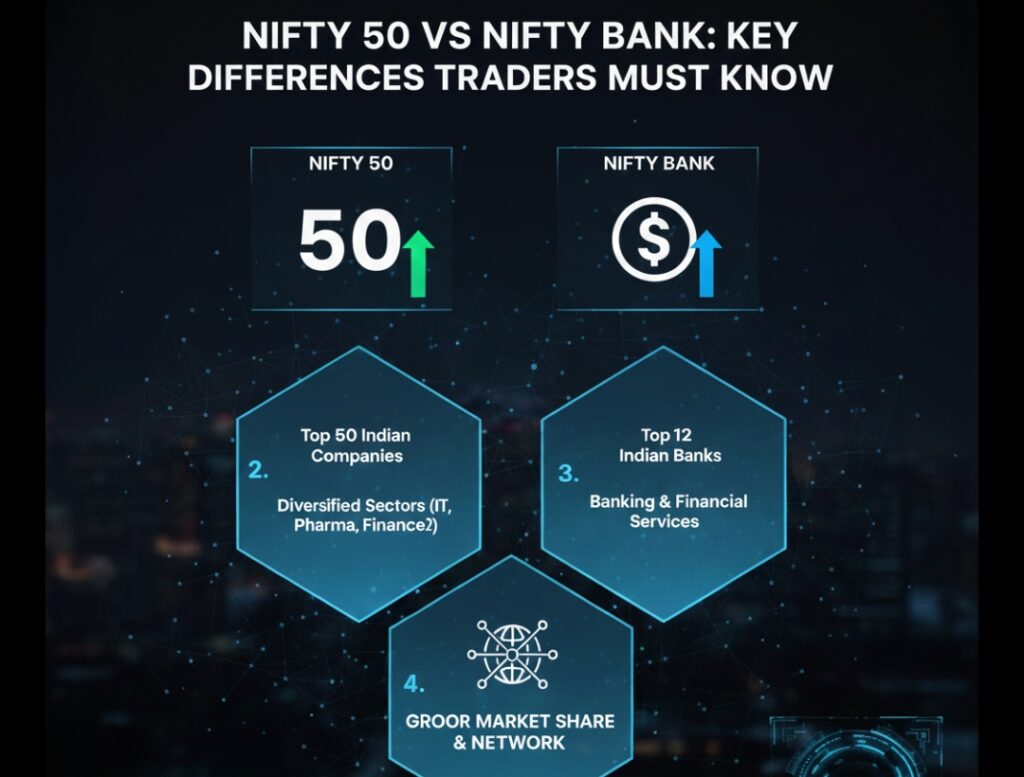
In the world of trade, Nifty 50 and Nifty Bank have different roles; one follows India’s top 50 firms in a variety of industries, while the other works on large banks. Since their moves don’t always match, traders often compare Nifty Bank to Nifty 50 when building tactics. Recent screenshots show Nifty Bank dipping amid HDFC and ICICI pressures, unlike steadier nifty 50 names.
Sector Scope Shapes Strategies
The Nifty 50 spreads risk among banks, IT, drugs, and cars; imagine Reliance or TCS producing large gains. Nifty Bank increases interest in rate cuts or loan problems by sticking to 12 lenders, such as SBI and HDFC Bank (33% weight). Diversification in nifty 50 cushions crashes; Nifty Bank surges on credit booms but stings in NPAs.
Weighty Players Pull the Strings
HDFC Bank dominates Nifty Bank at over 30%, with ICICI and Kotak chasing—any earnings miss shakes the pack. Nifty 50 caps leaders like HDFC under 10%, blending Adani Ports’ volatility with HUL stability. Capping keeps nifty 50 fair; Nifty Bank rides top dogs harder.
Volatility: Wild Ride vs Steady Trek
Nifty Bank swings fiercer—beta over 1.2 versus nifty 50’s 1.0—thanks to RBI policy jitters. Day ranges hit 2-3% in banks, per recent charts, while nifty 50 hovers calmer at 1-2%. Options traders love Nifty Bank’s theta decay; long-term folks hug nifty 50 peace.
Returns Race Heats Up Long-Term
Since 2000, Nifty Bank clocks 17% CAGR, outpacing nifty 50’s 12%—but with sharper dips like 2020’s 40% plunge. Post-COVID, banks rebounded 3x faster to 52,000 peaks by late 2025. Nifty 50 delivers consistent 15% TRI over 25 years, suiting SIPs better.
Trading Hours Twist the Game
Nifty 50 trades full 9:15-3:30 sessions; Nifty Bank cuts short to 9:15-2:30, slashing option expiry chaos. F&O volumes explode in Nifty Bank—India’s hottest derivatives—versus balanced nifty 50 flow. Shorter windows spike intraday bets; full days favor positional plays.
Rebalance Rhythms Refresh Rosters
Both tweak semi-annually—March and September—using free-float market cap from Nifty 500 pools. Nifty Bank demands 90% trading frequency and F&O listing; nifty 50 eyes liquidity under 0.5% impact cost. Stocks like AU Small Finance joined banks lately, boosting small-cap flavor.
Calculation Crunch Mirrors Markets
Free-float cap weights both: Index = (Current FF MCap / Base FF MCap) x 1000 base. Nifty Bank caps single stock at 33%, top three at 62%; nifty 50 freer but impact-adjusted. Corporate actions like bonuses adjust smoothly, keeping mirrors clean.
Investment Paths Diverge Smartly
ETFs and index funds track both—Nippon’s Nifty Bank BeES yields 18% annualized lately. Direct stock buys mimic weights; Nifty 50 suits beginners, Nifty Bank for sector bulls. Derivatives shine brighter in banks due to volume—traders eye weekly expiries.
Risk Radar for Trader Tactics
Nifty 50 weathers recessions via FMCG buffers; Nifty Bank tanks on moratoriums but rockets on reforms. Correlation hits 0.85, yet banks lead rallies 60% of time since 2010. Blend both for portfolios—nifty 50 core, Nifty Bank tactical tilt.
Verdict: Match to Your Market Mood
Newbies pick nifty 50 for sleep-easy diversification; aggressors chase Nifty Bank volatility. Screenshots confirm banks’ chop—AU up 0.11%, Canara down 1%—while nifty 50 Adani Ports leaps. Track via NSE live; align with your risk appetite.

